
- Las Vegas Raiders – Fernando Mendoza, QB, Indiana
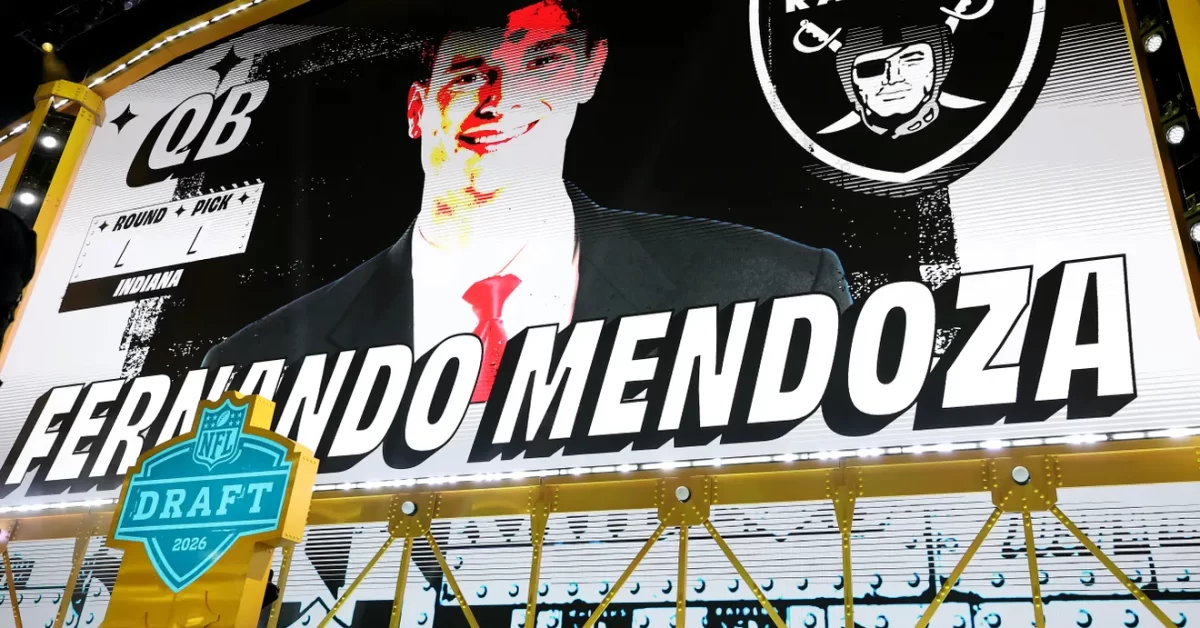
The Las Vegas Raiders made the expected move by selecting Fernando Mendoza with the first overall pick, solidifying him as the face of the franchise moving forward. While not viewed as a once-in-a-generation prospect, Mendoza earned the top spot with his strong arm talent, aggressive playstyle, and ability to deliver in extremely high-pressure moments throughout his college career. Paired with veteran Kirk Cousins as a potential mentor, Mendoza enters a situation that could help maximize both his physical tools and his competitive mindset. There are still some question marks surrounding his reliance on the supporting cast around him, and his transition to the NFL could be heavily skewed based on how the Raiders build the team around him.
2. New York Jets – David Bailey, ED, Texas Tech
The New York Jets took an aggressive, multi-layered approach in the first round, headlined by selecting David Bailey with the second overall pick. In a draft class lacking a clear-cut blue-chip superstar, Bailey emerged as the “safest” elite option – a dynamic edge rusher with burst, speed, and the ability to consistently pressure the quarterback. Bailey does have his limitations, particularly against the run; however, his lack of standout red flags, such as Rueben Bain’s historical short arms and Arvell Reese’s positional questions, make him the logical choice for the Jets, who are looking to rebuild a struggling defense.
3. Arizona Cardinals – Jeremiyah Love, RB, Notre Dame
The Arizona Cardinals made one of the most surprising moves of the draft by selecting Jeremiyah Love at third overall. On one hand, Love is widely viewed as an elite talent; he is a rare combination of speed, power, and receiving ability, and he has tempting big-play potential and versatility that make him a dangerous addition to ANY offense. From a pure talent perspective, the Cardinals can justify the pick as they are taking the best player available. However, the decision raises valid concerns about positional value and overall roster construction, particularly given Arizona’s already crowded running back room and some lingering issues along the offensive line. Investing a top-three pick into a running back, especially when the infrastructure needed to maximize his impact may not yet be in place, is a risky gamble that could either prove dividends in the future or set the franchise back.
4. Tennessee Titans – Carnell Tate, WR, Ohio State
The Tennessee Titans took a bold move by selecting Carnell Tate, further showing their commitment to invest in offensive support for young quarterback Cam Ward. Tate is viewed as a highly polished receiver with strong route-running, separation ability, and consistent production at the intermediate and deep levels, as well as being one of the most polished true “X” wide receiver prospects we have seen in a few years. There are some concerns surrounding his overall top-speed, but his tape is clean, and he is routinely creating space and winning downfield. By adding Tate to a receiving corps that already includes names like Calvin Ridley and Wan’Dale Robinson, the Titans are accelerating Ward’s development and setting Ward up with the best potential to succeed.
5. New York Giants – Arvell Reese, ED, Ohio State
The New York Giants had made an interesting move by selecting Arvell Reese at number five overall. Reese had many discussions about going somewhere in the top three, and the Giants were lucky that they fell all the way to five. Reese’s appeal lies in his rare hybrid skill set; he is capable of functioning both as an off-ball linebacker and a pass-rush threat off the edge. In a defensive system that already features multiple versatile pieces like Abdul Carter, Kayvon Thibodeaux, and Brian Burns, Reese adds another layer of unpredictability and schematic flexibility that could allow New York to constantly disguise pressure packages. Reese’s value depends heavily on how creatively the Giants deploy him, and what separates Reese from similar past prospects is his demonstrated ability to play multiple assignments successfully. If the Giants are truly able to unlock that, the sky is the limit for Reese.
6. Kansas City Chiefs – Mansoor Delane, CB, LSU (Trade Up)
The Kansas City Chiefs made an aggressive move by trading up from pick nine to six, ultimately selecting Mansoor Delane, widely regarded as the top cornerback in the class. Delane has elite traits, a fluid mover, strong ball skills, press coverage ability, and a verified 4.38 speed, all of which solidified him as a true blue-chip defensive back in this class. For a defensive scheme under Steve Spagnuolo that thrives on man coverage and trust in outside corners, Delane projects as a plug-and-play difference-maker and a potential long-term replacement for Trent McDuffie.
7. Washington Commanders – Sonny Styles, LB, Ohio State
The Washington Commanders continued their defensive rebuild by selecting Sonny Styles at pick seven. Styles is a rare athletic profile at linebacker; he is long, fast, and built like a modern hybrid defender, as he is a former safety transitioning into a more traditional linebacker role. The positional history shows up in his game, particularly in coverage, where he demonstrates strong zone awareness and the ability to read routes developing behind him, something many linebackers struggle with. Styles can be deployed in multiple ways: as a traditional linebacker, a zone coverage defender, or even as a situational pass rusher. His athletic testing and flashes as a blitzer suggest untapped upside in that phase of the game. While he is not viewed as a generational linebacker prospect, his all-around skill set makes him a strong three-down defender with significant upside still to develop.
8. New Orleans Saints – Jordyn Tyson, WR, Arizona State
The New Orleans Saints’ selection of Jordyn Tyson at pick eight is a clear upside-driven bet on one of the most explosive and volatile wide receiver prospects in the class. Tyson’s appeal centers on his elite suddenness, twitch, and ability to consistently create separation through route running rather than physical dominance. However, the pick comes with real risk: a notable injury history and concerns about his ability to consistently handle contact and a full season of NFL receptions. In essence, the Saints are betting that Tyson’s dynamic athletic profile and ceiling as a primary offensive weapon outweigh the durability and physicality concerns, making this a high-variance swing on long-term offensive impact.
9. Cleveland Browns – Spencer Fano, T, Utah (Trade Down)
The Cleveland Browns moved from pick six to nine in a trade-down with the Kansas City Chiefs, ultimately selecting Spencer Fano, arguably one of the best offensive line prospects on the board. Fano projects as a plug-and-play starter who can realistically play multiple positions across the offensive line, with legitimate competition between left tackle, right tackle, and even interior roles depending on how the Browns structure their unit. Despite concerns about arm length falling just below preferred NFL thresholds, his elite technique, athleticism, and hand usage mitigate those concerns on tape, allowing him to project as a high-floor, multi-positional offensive lineman in a league where versatility is increasingly valuable. From a process standpoint, the Browns’ decision to trade down is a great example of maximizing value rather than simply picking at a specific spot. With top-tier skill players like Carnell Tate off the board earlier than expected, Cleveland pivoted into a trade-down strategy that still landed a premium offensive lineman while recouping future assets. Overall, an amazing move for the Browns, both in the player drafted and trading down.
10. New York Giants – Francis Mauigoa, OL, Miami
The New York Giants’ selection of Francis Mauigoa is a clear attempt to add some stability to the offensive line. He can be viewed as a potential long-term guard or tackle, and the flexibility gives New York a valuable insurance policy in case of injury along the offensive line. At 6-foot-5, 330 pounds, his defining trait is his raw power at the point of attack, as he consistently moves defenders in the run game and brings a tone-setting presence. When thinking about the Giants’ pick of Reese in addition to this pick, you can see that the Giants are looking to add versatile players to help solidify both sides of the ball.
11. Dallas Cowboys – Caleb Downs, S, Ohio State (Trade Up)
The Dallas Cowboys were aggressive early in the first round, trading up from pick twelve to eleven in order to secure Caleb Downs and prevent another team from trading up to draft him. Downs is one of the most complete defensive players in the draft, with elite processing speed, leadership qualities, positional versatility, and the ability to impact the game from multiple alignments, whether that is at deep safety, box defender, or slot coverage. Despite not having elite testing numbers, his tape is defined by anticipation and intelligence, and I fear that the NFL overthought him, and the Cowboys will be landing a defensive difference-maker.
12. Miami Dolphins – Kadyn Proctor, OL, Alabama (Trade Down)
Kadyn Proctor is one of the most polarizing prospects in the class, he is physically enormous at 350-plus pounds with rare movement skills for his size, but with inconsistent tape that reflects lapses in technique, conditioning, and consistency. The Dolphins are clearly betting on the upside of Proctor, believing that his best snaps represent what he can become full-time if developed properly. However, the concerns are real: questions about his self-discipline, conditioning habits, and ability to maintain focus through long NFL seasons. From a schematic standpoint, the Dolphins appear to view Proctor primarily as a guard conversion rather than a pure tackle, which helps mitigate some of his biggest weaknesses by reducing space and simplifying his assignments. If Proctor is coached and conditioned properly, he has legitimate Pro Bowl-caliber traits, but if not, he risks becoming another in a long line of physically gifted but underwhelming offensive line projections.
13. Los Angeles Rams – Ty Simpson, QB, Alabama
The Los Angeles Rams made one of the most shocking moves of the first round by selecting Ty Simpson at pick 13, a decision that immediately sparked league-wide reaction not just because of the player, but because of the organizational dynamics surrounding it. Simpson’s profile is that of a high-variance quarterback prospect, as he has limited starting experience with just 15 career starts, and some significant concerns about accuracy and consistency. However, the Rams clearly view him as a long-term developmental investment rather than an immediate contributor, as Matthew Stafford is coming off an MVP season. Ultimately, this is a future-oriented bet made from a position of strength, but one that hinges entirely on whether Simpson’s developmental trajectory can justify passing on a more certain short-term impact.
14. Baltimore Ravens – Olaivavega Ioane, G, Penn State
The Baltimore Ravens addressed the interior offensive line with the selection of Ioane in the first round. Ioane profiles as a classic power guard prospect, an imposing, movement-oriented lineman who consistently generates displacement at the point of attack and wins through strength, leverage, and physical dominance rather than finesse or lateral athleticism. His game is defined by his ability to overwhelm defenders once contact is initiated, often neutralizing bull rushes and creating clear lanes in the run game, even if his technique and footwork can be inconsistent. Overall, Baltimore is adding a starting-caliber guard who has an extremely high floor.
15. Tampa Bay Buccaneers – Reuben Bain Jr , ED, Miami
The Tampa Bay Buccaneers made one of the best value picks of the first round by landing Rueben Bain at pick 15. Bain was widely projected to have come off the board much earlier in the first round, and his slide into the mid-teens created a scenario where Tampa Bay was able to acquire what many evaluators viewed as one of the most disruptive defensive players in the class without needing to move up. His profile is defined by overwhelming play strength and consistent pocket disruption; he is not a prototype speed rusher, but rather a forceful edge defender who wins through leverage, hand power, and the ability to collapse protection schemes with sustained physical pressure. Even when his measurables, particularly arm length and listed weight, raised questions during the pre-draft process, his on-field dominance against high-level offensive lines kept him firmly in the first-round conversation. Ultimately, this is a class Buccaneers-style value pick: a highly productive, physically dominant defensive lineman who may not fit every prototype but consistently wins in the most important way, by collapsing protection and forcing quarterbacks off their spots.
16. New York Jets – Kenyon Sadiq, TE, Oregon
The New York Jets pivoted from an expected wide receiver selection and instead chose Kenyon Sadiq, a move that initially surprised but ultimately reinforced their commitment to versatile playmakers. Sadiq stands out as a unique tight end prospect. He is physically powerful, explosive in space, and capable as both a blocker and a vertical threat. He will need to develop his route-running and some natural zone awareness, but his athleticism and playmaking ability give him a high ceiling in the NFL.
17. Detroit Lions – Blake Miller, T, Clemson
The Detroit Lions desperately needed to address the offensive line entering the first day of the draft. Miller profiles a high floor right tackle who brings extensive collegiate experience along with consistent performance in both pass protection and the run game. While he may not possess the elite athletic upside or positional flexibility of some other tackles in the class, his value lies in reliability. If he transitions smoothly to the NFL, this pick may not generate immediate headlines, but it could quietly stabilize one of the most important units on the roster from day one.
18. Minnesota Vikings – Caleb Banks, DT, Florida
The Minnesota Vikings made the more surprising selections of the first round by taking Caleb Banks at pick 18. Banks is a textbook “traits-over-production” defensive tackle, measuring at 6-foot-6, 330 pounds with rare explosiveness for his size, long arms, and elite raw power that shows in flashes of outright dominance. However, the Vikings are clearly betting on projection rather than consistency, and that is where the pick becomes complicated. Banks’ production profile never matched his physical tools, having inconsistent run defense, a relatively low run-stop impact rate, and stretches where he failed to sustain dominance despite clear physical advantages. The biggest red flag, however, is medical. Banks enters the league with a repeated foot injury history centered on the same left foot, including multiple fractures and setbacks across multiple seasons. Overall, this is a bet on traits, coaching development, and medical optimism all aligning at once
19. Carolina Panthers – Monroe Freeling, T, Georgia
The Carolina Panthers selected Monroe Freeling at pick 19, continuing their investment in the offensive line by taking a high-upside developmental left tackle with rare athletic traits but clear refinement needs. Freeling has excellent size, movement skills, and testing numbers that show up in flashes. However, his game is still inconsistent, particularly in the run game, where he can be displaced by power and hasn’t yet developed reliable core strength or anchor consistency, while his pass protection technique still needs work in hand placement, leverage, and timing. Because of that, he projects more as a developmental starter than a day-one solution, which fits Carolina’s situation, given Rasheed Walker as a short-term bridge and Ikem Ekwonu’s injury uncertainty, providing flexibility on the timeline.
20. Philadelphia Eagles – Makai Lemon, WR, USC (Trade Up)
The Eagles traded up from pick 20 to pick 23 to select Makai Lemon. Lemon projects as a polished, high-floor receiver who wins with route detail, timing, and consistent separation rather than elite physical traits, profiling more as a strong WR2 who can function across the formation than a true dominant X receiver who thrives through press coverage. Philadelphia adds a dependable separator who strengthens depth and technical precision at receiver who projects as the Eagles’ long-term option as the slot receiver.
21. Pittsburgh Steelers – Max Iheanachor, T, Arizona State
The Pittsburgh Steelers chose to select Max Iheanachor at 21, further solidifying a rather inconsistent offensive line. Iheanachor is still a rather raw prospect in both the passing game and the running game, due to him being relatively new to playing football, as he played soccer in Nigeria and basketball in high school before playing football, but he is an incredible athlete and projects as a high upside future right tackle for the Steelers.
22. Los Angeles Chargers – Akheem Mesidor, ED, Miami
Akheem Mesidor is one of the most pro-ready prospects in the entire draft. Mesidor is an extremely violent pass rusher and is a disruptor playing all over the defensive line, despite Mesidor being 25 years old at the time of the draft. If a team were to draft Mesidor, it would need to be a team that is looking to win now, and the Chargers are in a window where they are looking to maximize the youth of the roster, pairing Mesidor with Khalil Mack and Tuli Tuipultou builds an extremely strong defensive line in Los Angeles.
23. Dallas Cowboys – Malachi Lawrence, ED, UCF (Trade Down)
Malachi Lawrence is a fascinating pick because he has slowly risen over the draft process. Lawrence brings elite pass-rush traits, including twitch, bend, and a variety of ways to win on the edge, which makes him especially appealing to teams betting on developmental upside at premium positions. He can stress offensive tackles immediately with athletic tools and natural pass-rush instincts that translate to pressure creation even while he continues refining his overall game. He will join an edge rush room with Donovan Ezeiruaku and Rashan Gary, and Lawrence won’t need to play every snap and can be used as more of a rotational pass rusher to start.
24. Cleveland Browns – KC Concepcion, WR, Texas A&M
The Cleveland Browns completed their draft-day strategy of drafting both an offensive lineman and a wide receiver by selecting KC Concepcion at pick 24. Concepcion is one of the most intriguing wide receiver prospects in the class due to his elite separation ability and overall athletic profile. He is widely regarded as arguably the best separator in the draft, with fluid movement skills, suddenness out of breaks, and a consistent ability to win against both man and zone coverage. However, there is some concern as he has inconsistent ball skills, with some occasional drops and double catches. Even so, at the end of the first round, the Browns are betting that his separation ability and versatility outweigh those limitations, giving them a dynamic offensive weapon.
25. Chicago Bears – Dillon Thieneman, S, Oregon
One of the biggest holes currently on the Bears’ roster was the lack of a starting safety to play with Coby Bryant. Dillon Thieneman fits the role that the Bears’ defense needed and has the ability to play numerous different roles. He can play as a true deep free safety, where he has extremely smart eyes to understand route combinations, as well as being able to read the quarterback’s eyes. He has the ability to match up against slot receivers and tight ends, as well as showing the versatility to play in the box. Thieneman might be one of the best true deep free safety prospects to enter the draft in a while, and the Bears are extremely lucky to have him fall down to 25.
26. Houston Texans – Keylan Rutledge, G, Georgia Tech (Trade Up)
The Houston Texans look to add more options to the offensive line and draft Keylan Rutledge at 26. Rutledge projects as an extremely versatile interior offensive lineman; there could be an option for Rutledge to move inside to center, in addition to already being a starting-caliber option. Rutledge might be considered a reach by some, but in most drafts, and in this class in particular, offensive lines are proven to be highly coveted, so Houston made the choice to trade up and get their guy. Rutledge has some development in his technique that will need to be addressed; he can tend to play with poorer leverage and will need to do a better job of not letting defensive lineman get under him. However, Rutledge is a mauler and should be a starter for the Texans.
27. Miami Dolphins – Chris Johnson, CB, San Diego State (Trade Up)
The Miami Dolphins traded up at the end of the first round to select Chris Johnson. Johnson separated himself from the other cornerbacks in the region of the draft, not because of overwhelming hype, but because he lacked a true red flag; his profile is more defined by what isn’t wrong with him than by any glaring flaw, aside from the typical skepticism tied to playing at San Diego State and questions about the strength of competition. Johnson adds a stable, relatively low-risk corner option who can early for playing time and potentially develop into a long-term starter, even if he isn’t viewed in the same elite tier as Delane.
28. New England Patriots – Caleb Lomu, OL, Utah (Trade Up)
In the same conversation as the Rutledge pick, Caleb Lomu was not projected to go this high, but when you look at the board at this stage of the draft, the options of starting offensive linemen are extremely thin. Lomu projects as a developmental tackle for the Patriots. He is a very good mover and shows good athleticism on tape. He has some ugly losses, and his technique can be sloppy at times, but he is still extremely young, and he will most likely be the future right tackle once Morgan Moses decides it is time to move on.
29. Kansas City Chiefs – Peter Woods, DT, Clemson
The selection of Peter Woods by the Kansas City Chiefs is a classic “buy-low” player who has tremendous upside, but has overall regressed throughout his college career. In his earlier years at Clemson, he showcased disruptive interior ability, strong hand usage, and the kind of block-shedding quickness that translates to the NFL. Despite concerns about limited arm length and inconsistent recent production, the Chiefs are betting on development upside, positional versatility, and the idea that his best football is ahead of him with proper development.
30. New York Jets – Omar Cooper Jr. , WR, Indiana (Trade Up)
The New York Jets capped off an impressive first round by trading back in to select Omar Cooper Jr. Cooper brings elite run-after-catch ability, with a physical, tackle-breaking style, paired with being at the elite at the catch point, and his ability to create yards in space add an extremely dynamic element to his offense. The overall Jets’ draft strategy reflects the long-term planning as they continue to navigate their quarterback situation with Geno Smith, who is serving as a temporary bridge, bringing in Sadiq and Cooper to be future contributors to whoever is the long-term starter for this team is a sound strategy.
31. Tennessee Titans – Keldric Faulk, DL, Auburn (Trade Up)
The Titans traded back in the first round to select Keldric Faulk, and after addressing the offense earlier with Carnell Tate, the Titans turned their attention to the defensive front, landing a potential high-upside edge defender with rare size, length, and athleticism. Faulk brings some versatility to the defensive line as he played both inside and outside along the line in college, and combining that with his strength as a run defender gives him a relatively high floor to be a rotational contributor. While his lack of pass-rush production in college raises some valid questions, his youth and physical tools suggest significant room for development, making him a more appealing gamble at the back end of the first round than he would have been earlier.
32. Seattle Seahawks – Jadarian Price, RB, Notre Dame
The only real true need that Seattle needed entering the draft, with the departure of Kenneth Walker and the injury of Zach Charbonnet, was to bite the bullet and select Price higher than most people thought he would be. It doesn’t help Seattle’s cause that they had very little wiggle room with only having four draft picks, and they wanted to make sure they could fill the hole. Price has some good breakaway ability and can be a weapon in the passing game, as well as having some good kick returning ability, and should be a capable running back for the Seahawks.
Cover Image Courtesy of Emily Chinn/Getty Images