

The numbers tell two very different stories.
LSU out gained Alabama 457-285, controlled the time of possession and recorded 27 first downs. Yet when the final whistle sounded Saturday afternoon inside Tiger Stadium, the Tigers found themselves on the wrong end of a 31-13 loss to the Crimson Tide.
For a team with aspirations of competing for an SEC championship and a spot in the College Football Playoff, the offensive production raises an important question: How can a team move the football so effectively but struggle to put points on the scoreboard?
Despite generating 457 total yards, LSU failed to find the end zone through the air and struggled to capitalize on several scoring opportunities. The Tigers converted just five of their 14 third-down attempts and went 0-for-4 on fourth down. Alabama, meanwhile, made the most of its opportunities, scoring on all three of its red-zone possessions.
The difference was not necessarily the ability to move the football. It was the ability to finish drives.
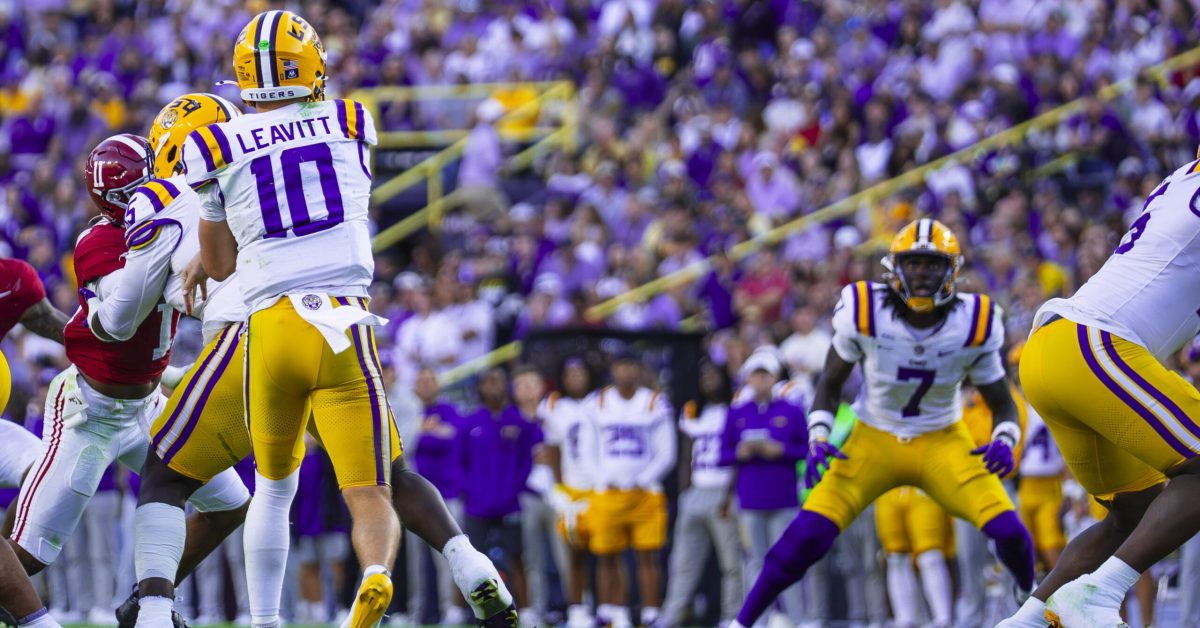
Quarterback Sam Leavitt completed 35 of 48 passes for 380 yards against Alabama, providing much of the Tigers’ offensive production. Wide receiver Jackson Harris was a major part of that success, recording 11 receptions for 166 yards.
However, the passing production did not translate into touchdowns. LSU’s inability to finish drives became increasingly costly as the game progressed, especially when the offense needed to respond to Alabama’s second-half momentum.
The rushing attack presented another concern. LSU finished with just 77 rushing yards on 33 attempts, averaging 2.3 yards per carry. Dilin Jones led the Tigers with 56 rushing yards and a touchdown, but the lack of consistent production on the ground made it difficult for LSU to establish a balanced offensive attack.
When a defense can anticipate the passing game, it becomes increasingly difficult for an offense to sustain drives and create opportunities.
Head coach Lane Kiffin acknowledged the issue following the loss, pointing directly to LSU’s inability to convert in critical situations.
The Tigers’ offensive struggles became especially apparent late in the game. After taking a 13-10 lead in the third quarter on a five-yard touchdown run by Jones, LSU watched Alabama respond with 21 unanswered points.
Rather than building on its momentum, the offense struggled to find another scoring opportunity as the Crimson Tide took control.
The loss also exposed the importance of execution in high-pressure situations. LSU had opportunities to extend its lead and keep Alabama from gaining momentum, but missed conversions and stalled drives ultimately shifted the game.
Now, the Tigers must turn their attention toward another difficult SEC matchup against Texas.
The Longhorns enter Saturday’s contest with one of the nation’s more productive defenses, creating an immediate challenge for an LSU offense that needs to find consistency. Texas defensive end Colin Simmons has been particularly disruptive, recording 10.5 sacks this season.
For Kiffin and his offensive staff, the upcoming matchup presents an opportunity to address the issues that surfaced against Alabama.
Establishing a more effective rushing attack, protecting Leavitt and improving third- and fourth-down execution will be essential. LSU cannot afford to repeatedly move the football between the 20-yard lines without finding ways to finish drives.
The Tigers have shown they are capable of generating offensive yardage. The next step is turning that production into points.
With Texas coming to Baton Rouge, LSU will have another opportunity to prove that its offense can perform against a top-ranked SEC opponent.
Because in a conference where every possession matters, 457 yards mean very little if they only produce 13 points.