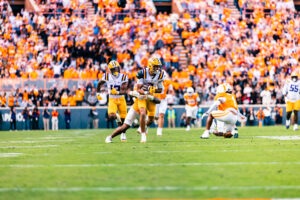
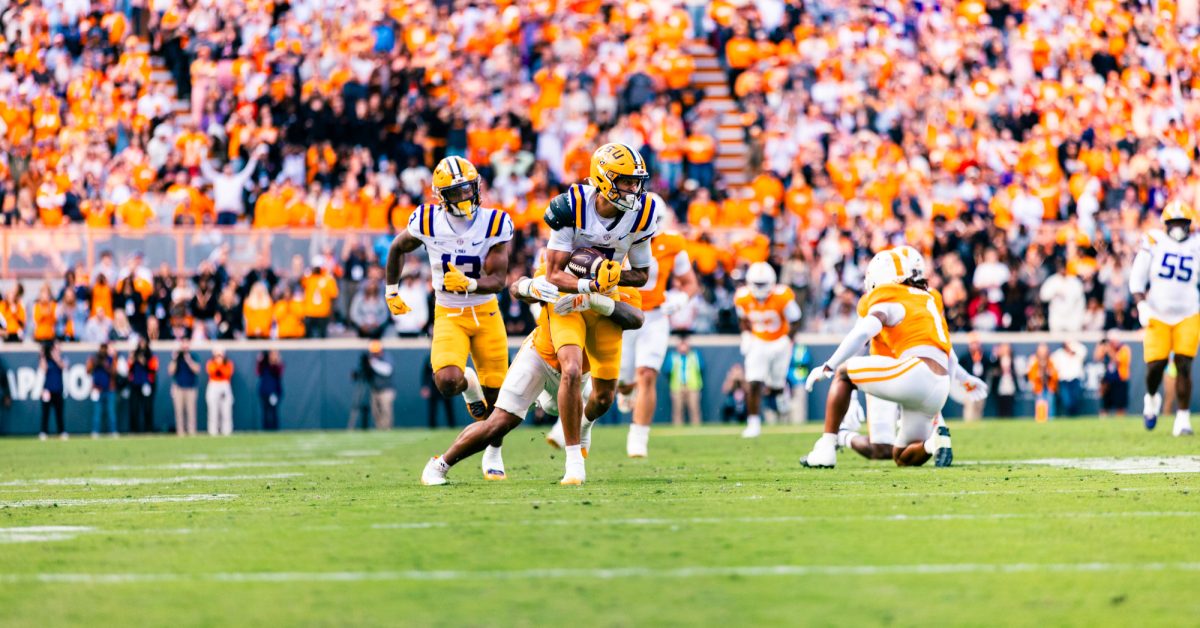

A cool afternoon in Knoxville, as the LSU Tigers take on the Tennessee Volunteers on the road for the first time since 2017. For one of the last games of the Tigers’ underwhelming season, ending with an offense that should be studied for its inefficient red zone plays, ending in another loss for the Tigers on the road.
After a tough loss against the Longhorns in Death Valley in week 11 of the 2026 season, it became abundantly clear that LSU’s offense, with Sam Leavitt at the helm, was never going to be any good.
From the beginning of the game, the LSU defense gave the offense a gift with a big red bow on it: a chance to score and make big plays against this No. 9 team.
Through every situation, there was one thing that continued to show up: the offense dropping the ball and not performing in the red zone. But although the offensive problems have been well documented throughout the season, there isn’t enough talk about the special-teams problems. Completely unacceptable is the only way to put what kind of performance this once strong-performing team has completely come undone.
In week three of this long football season, when LSU took to the road to Lane Kiffin’s former school, Kiffin said after the game that the noise did far more to the Tigers than expected. After a performance that just wasn’t enough, the warning signs started to come back: the team couldn’t perform or complete due to stadium noise.
“The fans, they were elite; that was the loudest, most effective crowd I’ve seen by a crowd,” Kiffin said. “So credit to them and credit to Tennessee for playing really well, especially defensively.
For a team that plays in the “Pantheon of College Football,” they sure don’t act like it.
In the final minutes of the first half, star player Ty Benefield, who helped LSU immensely with eight tackles, one forced fumble and two solo tackles, was ejected for targeting, which ultimately ended in a touchdown with just 15 seconds left. Going into the half trailing by four, didn’t even begin to describe how pitiful the LSU offense was.
But the real question became: what is the definition of targeting? Countless plays have been made during games that should’ve been called, like during the first quarter after a head to the abdomen of Eugene Wilson III. The targeting rule needs to be changed and made clear: going after the ball with your head to knock it out and having it end in targeting isn’t normal protocol.
Blake Baker’s defense spent 30 minutes fighting and clawing to save LSU from itself, but still couldn’t muster the power. Racking up eight pre-snap penalties in just one half, LSU also fumbled, threw wide-open passes and couldn’t get rid of the ball.
By the third quarter, LSU had seven unanswered points, and it didn’t seem to be in sight but after a recovered ball by PJ Woodland, the first Tiger touchdown came to tie a game in Knoxville with just one quarter left; the air suddenly became stiff.
That stiff air carried in the form of hostility for the Tigers with deep into the fourth quarter, golf balls, mustard and almost every cuss word imaginable as the Volunteers were up by 14 points. The hostility surrounding Lane Kiffin’s return to Rocky Top matched the hostility the Ole Miss Rebels displayed toward the Tigers.
As the final two touchdowns that the Volunteers were able to grab from the LSU defense tallied up on the board, the hopes that once were alive faded into a far distant memory just like the hopes of a national championship team.
The Tigers are set to take on the Arkansas Razorbacks on Saturday, 11/28 for the final regular game of the season before their fate is decided on the bowl game they’ll participate in.