
In college football, trophies often become as iconic as the games themselves. From crystal footballs to golden helmets, each tells a story about tradition and identity.
Few capture the spirit of their host city quite like the Fiesta Bowl Trophy, a piece that blends Southwestern culture, craftsmanship and the pageantry of one of the sport’s premier bowl games.
The Fiesta Bowl was founded in 1971 in Tempe, Arizona, to bring national attention to college football in the Southwest. Early Fiesta Bowl trophies were relatively simple, reflecting the game’s status as a young postseason contest still finding its place among established bowls.
As the Fiesta Bowl grew in prestige—eventually becoming part of the Bowl Coalition, Bowl Alliance and later the College Football Playoff—the trophy evolved alongside it.
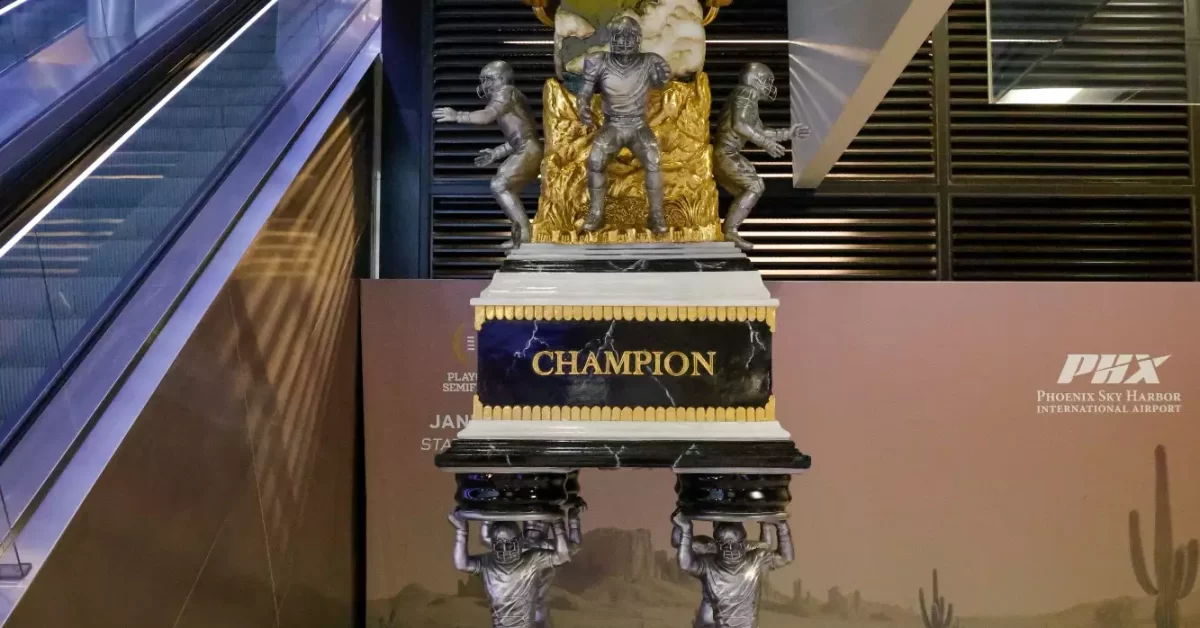
The modern Fiesta Bowl Trophy is instantly recognizable for its bold, geometric shape and vibrant design, a deliberate nod to Arizona’s desert landscape and rich cultural heritage. The trophy is anchored by a large, angular base that evokes the natural rock formations of the Southwest.
Rising from that base are sleek, vertical elements that give the trophy height and presence, symbolizing the ascent teams must make to reach the game. Originally made of wood to resemble the Heisman Trophy, the Fiesta Bowl Board of Directors decided in 2002to give it a more impressive, bold look.
Al Molina, a Fiesta Bowl Yellow Jacket Committee member, was also an internationally recognized jeweler. They tasked Molina with what would become a masterpiece of a trophy. With no budget, no guidelines and free rein over the design, the executive committee spearheaded by Christopher Olsen set out on a mission to create a historical masterpiece of a trophy.
At the center of the trophy sits the Fiesta Bowl emblem, often accented with colorful detailing that reflects the “fiesta” theme—celebration, energy and community. Unlike more traditional silver cups, the Fiesta Bowl Trophy incorporates color as a defining feature, setting it apart visually from nearly every other major bowl trophy in college football.
The sterling silver dome alone, enhanced with multi-colored windows created in jeweler’s enamel, took more than 96 hours to complete. This design choice reinforces the game’s identity as a vibrant, modern event rather than one rooted solely in old-school tradition.
Construction of the trophy is a meticulous process. It is crafted using a combination of metal, acrylic, and polished finishes to create both durability and shine under stadium lights. The materials are chosen not just for aesthetics but for longevity, ensuring the trophy can be passed, displayed, and photographed year after year without losing its luster. Each component is assembled with precision, resulting in a piece that feels both contemporary and ceremonial.
Over the years, subtle updates have been made to the trophy to reflect new sponsors, branding changes, and the Fiesta Bowl’s role on the national stage—especially during its time as a College Football Playoff semifinal host.
Weighing more than 200 pounds, the trophy design team knew even the strongest football team wouldn’t be able to hold it up in celebration after their Fiesta Bowl victory. This sparked the idea of the removable football, but not just any football. Made of 18-karat gold with jeweler’s enameled Fiesta Bowl sunburst marks, this football flaunts 2,187 pavé-set diamonds.
Yet the core structure has remained consistent, preserving the design language that fans and players now associate with the game.
For the teams that hoist it, the Fiesta Bowl Trophy represents more than a postseason victory. It stands as a symbol of excellence earned on one of college football’s biggest stages, wrapped in the colors and culture of the desert. In a sport steeped in tradition, the Fiesta Bowl Trophy proves that history can be built not just by looking back, but by boldly embracing a sense of place and celebration.