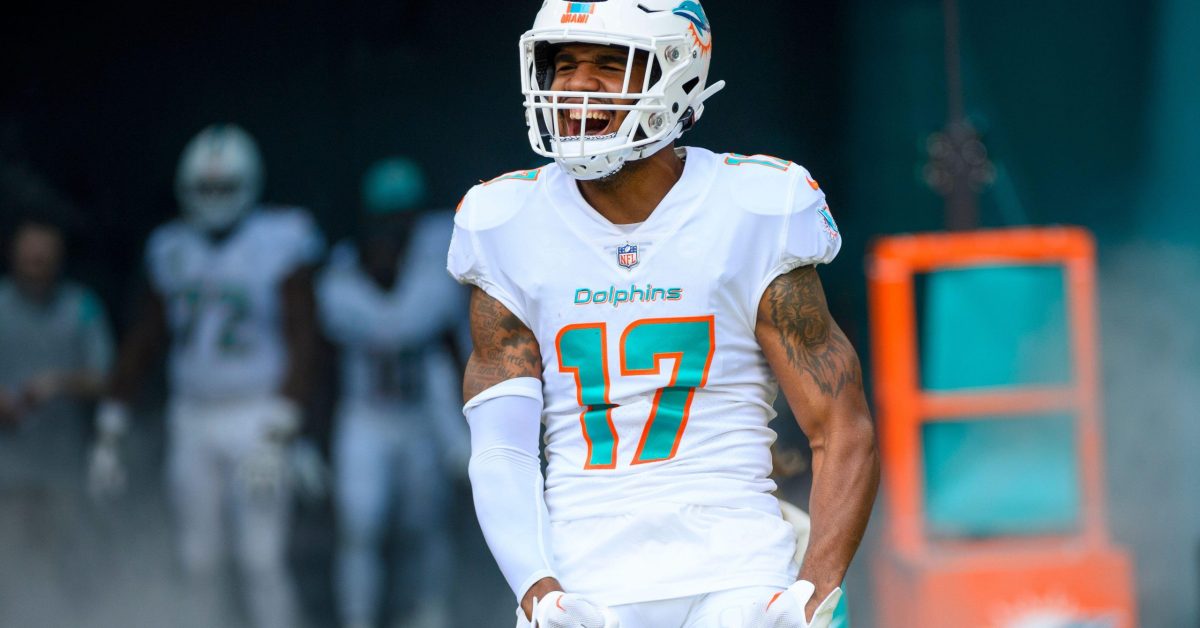

The trade sending Jaylen Waddle from the Miami Dolphins to the Denver Broncos for a first-round pick, a third-round pick, and a fourth-round pick swap has the potential to become one of the most impactful moves of the NFL offseason. This deal reflects two franchises heading in completely opposite directions, with Denver aggressively building around a young quarterback, and Miami fully committing to a long-term rebuild.
From Denver’s perspective, the move is a clear and decisive statement: they are ready to maximize their competitive window. The Broncos had been relatively quiet in free agency, a reflection of their roster’s lack of major glaring weaknesses. Instead, their biggest question mark was the overall explosiveness of the offense, specifically whether young quarterback Bo Nix had enough playmaking talent around him to succeed when competing against other high-powered offenses.
By acquiring Waddle, Denver answers that question. Waddle brings elite speed, vertical threat ability, and proven production at the NFL level. More importantly, his skill set complements the existing receiving corps, particularly Courtland Sutton, who operates more effectively as a possession receiver. This pairing creates a balanced and versatile passing attack, allowing Denver to threaten defenses at multiple levels of the field. When you combine Waddle and Sutton with younger players like Marvin Mims and Troy Franklin, the Broncos now boast one of the deepest wide receiver groups in the league, with multiple different skillsets.
The strategic significance of this move lies in its support for Nix’s development. Young quarterbacks often struggle not because of their own limitations, but because of insufficient surrounding talent. By adding a player like Waddle, Denver is effectively insulating Nix from those risks, and the offense will no longer be reliant on scheme or efficiency alone and now has the ability to generate explosive plays. Equally important is the value Denver gave up, relative to this draft class. The Broncos traded a late first-round pick, the 30th overall selection, along with additional assets, but in a draft class widely perceived as weaker, particularly in the later stages of the first round, this decision reflects a broader league trend: teams are increasingly willing to exchange uncertain draft capital for proven talent, rather than hoping to draft a player who might become a Waddle-level contributor.
In contrast, Miami’s side of the trade reflects a franchise that is undergoing a complete philosophical shift. After years of aggressive, star-driven roster building, highlighted by acquisitions like Tyreek Hill and Jalen Ramsey, the Dolphins are now embracing a full rebuild. The departure of Waddle is part of a broader effort to strip the roster down, accumulate draft capital, and reset the salary cap.
From a big-picture perspective, this approach is logical and oftentimes turns into long-term success since Miami has committed to becoming younger, cheaper, and more sustainable. By trading Waddle, they add valuable draft assets and continue to clear financial obligations from the previous regime. This is no surprise as the general manager, John-Eric Sullivan and head coach, Jeff Hafley, were formerly with the Green Bay Packers and this is a strategy the Packers used to build long-term success.
However, the execution of this plan raises some important questions, particularly surrounding the quarterback position. Miami recently invested in Malik Willis, signaling at least some level of belief in his potential as a starter. Yet, by trading away Waddle and failing to maintain a functional receiving corps, the Dolphins are placing Willis in an extremely difficult position. This creates a fundamental contradiction. On one hand, Miami appears to want to evaluate Willis as a potential long-term solution. On the other hand, they are removing the very support structure necessary for that evaluation, quarterback development is heavily dependent on surrounding talent, and expecting Willis to succeed with a depleted roster undermines the team’s ability to accurately assess his capabilities. If Miami’s intention is a full rebuild, a more coherent approach might have been to delay investing in a quarterback altogether, in order to build up the roster and supporting cast before inserting a young quarterback into the mix.
Ultimately, the Waddle trade shows two contrasting philosophies. Denver is leveraging its existing roster strength to maximize the potential of a young quarterback, even at the cost of draft capital. Miami, meanwhile, is prioritizing long-term flexibility and asset accumulation, even if it means short-term struggles.
The success of this trade will depend on how effectively each team executes its broader strategy. If Waddle elevates Denver’s offense and accelerates Nix’s development, the move could position the Broncos as legitimate contenders. Conversely, if Miami successfully uses its draft capital to build a cohesive, young roster, the trade could spark the beginning of a successful rebuild.
Cover Image Courtesy of AP Photos/Doug Murray