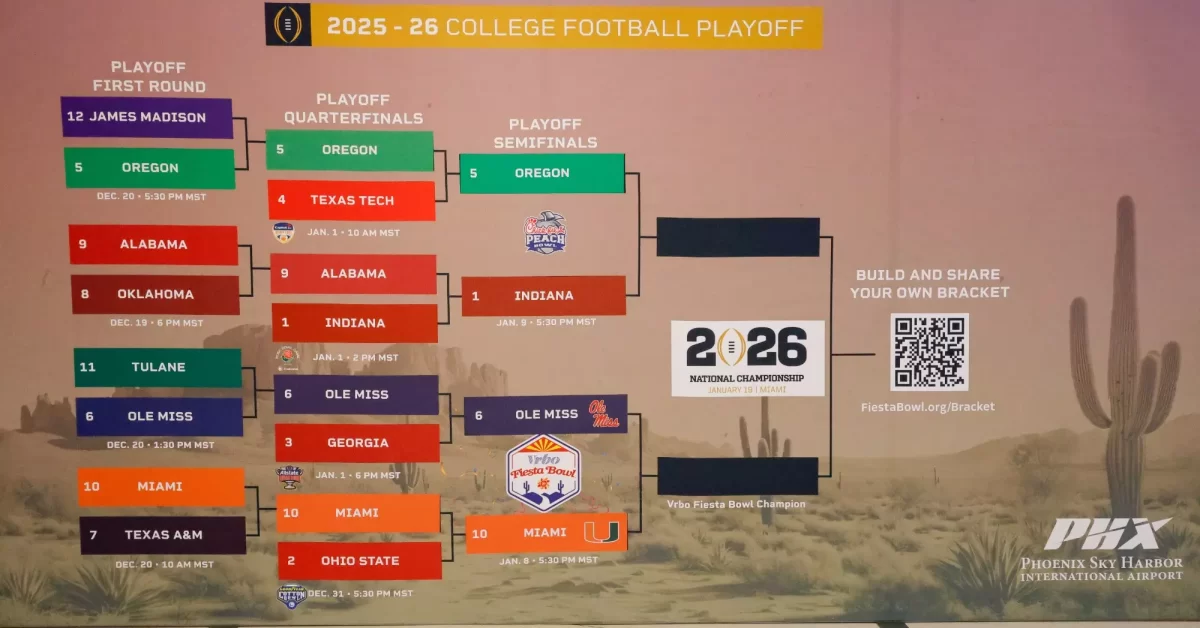

It’s the week of the Fiesta Bowl, and the buzz is picking up as the Ole Miss Rebels are set to take on an aggressive and big front-seven Miami Hurricane team. At the center of it all is quarterback Trinidad Chambliss, a fifth-year senior who is at the center of attention for his petition to gain a sixth year of NCAA eligibility.
But how will the Ole Miss offense be able to shake an experienced, aggressive and relentless Miami defense?
Ole Miss enters the matchup with one of the SEC’s more efficient offenses, but the challenge posed by Miami’s front seven is unlike most the Rebels have faced this season. The Hurricanes are built to disrupt the run game early and force quarterbacks into uncomfortable third-and-long situations, relying on size, speed and physicality at the point of attack.
Miami’s defensive line has been the backbone of its success. Anchored by veteran interior linemen and complemented by edge rushers who can collapse the pocket, the Hurricanes excel at controlling the line of scrimmage.
Ranking amongst the nation’s best in tackles for loss, consistently winning first contact and limiting rushing lanes before they develop.
That puts pressure on Ole Miss’s offensive line, a unit that has shown flashes of dominance but has also struggled at times against physical fronts. The Rebels’ ability to establish the run will be critical, not only to move the chains but to slow down Miami’s pass rush. If Ole Miss can generate early success on the ground, it will force Miami’s linebackers to play downhill, opening up play-action opportunities for Chambliss.
“For me, it was more of his composure, probably than anything. And he doesn’t get too high, doesn’t get to low, doesn’t get rattled. But he’s a natural competitor. He’s playing to win and that’s what I’ve always loved about him,” Ole Miss head coach Pete Golding said regarding Chambliss.
Chambliss’ mobility could also play a key role. While not known primarily as a runner, the quarterback has shown the ability to extend plays and pick up yards when protection breaks down. Designed rollouts and quick-release passing concepts may help neutralize Miami’s pressure and keep Chambliss upright.
Ole Miss offensive coordinator adjustments will likely center on tempo and spacing. Quick screens, slants and check-downs to running backs can serve as extensions of the run game, forcing Miami’s linebackers to cover sideline to sideline rather than attack straight ahead. The Rebels may also rely on misdirection and pre-snap motion to slow Miami’s defensive reads.
Miami’s linebacking corps is experienced and disciplined, but it has shown vulnerability against offenses that spread the field and attack mismatches in space. Ole Miss’ skill position players will need to win one-on-one battles, particularly on early downs, to stay ahead of the chains.
“Yeah, they got dudes. Their front seven, their defensive line, they got dudes up front,” quarterback Trinidad Chambliss said. “And I know Coach Cristobal will get those guys ready.”
The Fiesta Bowl may hinge on whether Ole Miss can dictate tempo or whether Miami’s front seven can impose its will. If the Hurricanes control the line of scrimmage and force Chambliss into predictable passing situations, Miami’s defense could dominate the game.
But if Ole Miss finds ways to balance its offense and limit negative plays, the Rebels could neutralize one of the nation’s more intimidating defensive units.
With postseason stakes high and individual futures in focus, the clash between Ole Miss’ offense and Miami’s front seven promises to be one of the defining storylines of the Fiesta Bowl.