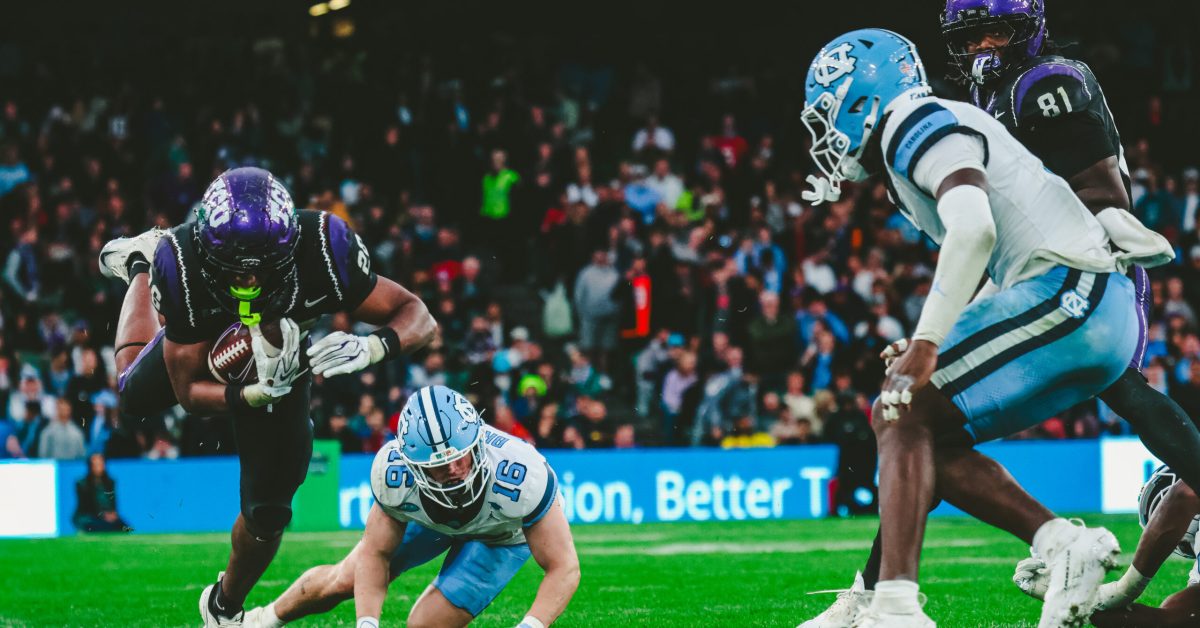

DUBLIN, Ireland Texas Christian University entered the 2026 season with a new quarterback, plenty of expectations, and an opportunity to make an early statement on an international stage. For one quarter Saturday at Aviva Stadium, the Horned Frogs looked ready to do exactly that.
But after a promising start, offensive miscues, penalties, and missed opportunities ultimately defined TCU’s season-opening 15-10 loss to North Carolina in the Aer Lingus College Football Classic.
The Horned Frogs scored 10 points on their opening two possessions and built an early 10-3 advantage. From there, however, TCU was held scoreless for the final 49 minutes as North Carolina’s defense repeatedly came up with stops when the Frogs threatened to regain control.
A Promising Start in Dublin
North Carolina opened the scoring with a 20-yard field goal, but TCU’s offense immediately answered.
Quarterback Jaden Craig, making his first career FBS start for the Horned Frogs after transferring from Harvard, helped move TCU 62 yards in seven plays. Kyle Lemmermann finished the possession with a 31-yard field goal to tie the game at three.
TCU quickly found another opportunity.
The Frogs drove deep into North Carolina territory, and running back Jon Denman finished the possession with a two-yard touchdown run. Lemmermann’s extra point gave TCU a 10-3 advantage with four minutes remaining in the opening quarter.
For an offense breaking in a new quarterback, it was about as encouraging of a start as TCU could have hoped for.
North Carolina answered almost immediately, however, marching 70 yards before Jaylen McGill scored from nine yards out to tie the game at 10.
What initially appeared to be developing into an offensive battle changed dramatically from there.
Jeremy Payne Becomes TCU’s Offensive Engine
If there was one performance TCU could unquestionably build upon coming out of Week 1, it belonged to Jeremy Payne.
The running back was the most productive offensive player on the field for the Horned Frogs, carrying the ball 25 times for 142 yards. He averaged 5.7 yards per attempt and produced a 48-yard run, the biggest rushing play of the afternoon for TCU.
Payne wasn’t limited to the ground game either.
He added five receptions for 27 yards, giving him 169 yards from scrimmage on 30 offensive touches.
His ability to create yards became especially important as TCU struggled to consistently generate explosive plays through the air. Whenever the Frogs needed offensive momentum, Payne was frequently the player capable of providing it.
His performance nearly helped TCU steal the game late.
With the Horned Frogs trailing 15-10 in the fourth quarter, TCU drove deep into North Carolina territory. Facing fourth-and-one from the UNC five-yard line, the Frogs put the ball in Payne’s hands.
North Carolina’s defense won the matchup.
Payne was stopped short, ending one of TCU’s best opportunities to take the lead.
The result of the play was frustrating, but the decision itself demonstrated how important Payne had become to the offense by the end of the afternoon.
Jaden Craig’s First Start Provides Something to Build On
Craig’s first game in purple wasn’t spectacular, but it showed why TCU entrusted him with the offense.
The former Harvard quarterback completed 20 of 32 passes for 175 yards and, importantly, did not throw an interception.
Craig showed composure early and helped TCU score on each of its first two possessions. He also demonstrated an ability to distribute the football underneath and keep possessions alive.
But North Carolina increasingly took away TCU’s passing game as the afternoon progressed.
The Frogs struggled to consistently create explosive plays through the air, forcing Craig to work through shorter completions while the Tar Heels tightened defensively.
TCU still had one final opportunity to change the story.
Trailing by five late in the fourth quarter, Craig and the offense reached North Carolina’s 10-yard line. On fourth-and-two, Craig rolled left looking for a receiver.
The pass fell incomplete.
Another promising possession ended without points, and North Carolina was able to run out the remaining time.
Craig’s debut therefore became a mixture of encouraging moments and missed opportunities: efficient stretches, no interceptions and some late-game composure, but ultimately not enough finishing ability inside scoring territory.
Ed Small Emerges as Craig’s Top Target
Wide receiver Ed Small immediately established himself as one of Craig’s most trusted options. Small caught a team-high nine passes for 65 yards, consistently providing Craig with a reliable target throughout the game.
The numbers weren’t built around one enormous play. Instead, Small’s impact came through volume and consistency.
With TCU trying to establish an offensive identity around a new quarterback, that connection could become increasingly important as the season progresses. Tight end Ka’Morreun Pimpton supplied TCU’s biggest passing play, turning his lone reception into a 40-yard gain.
The combination showed two different elements TCU will need going forward: Small as a dependable chain-moving target and Pimpton as a potential source of explosiveness.
One Mistake Changes the Game
The sequence that ultimately changed the complexion of the afternoon came shortly before halftime.
With the game tied at 10, a snap sailed over punter John Hoyet Chance and toward the TCU end zone. Chance eventually kicked the loose football through the back of the end zone.
The result was a safety.
Instead of entering halftime tied, TCU suddenly trailed 12-10.
North Carolina added a 28-yard Aeron Burrell field goal early in the third quarter to extend the lead to 15-10. Those five unanswered points proved to be the difference.
The safety was particularly costly because neither offense scored a touchdown after the first quarter. In a game decided by five points, one special-teams breakdown became impossible to overcome.
Penalties Make TCU’s Margin for Error Even Smaller
The safety wasn’t TCU’s only self-inflicted problem.
The Horned Frogs were penalized 11 times for 89 yards, compared with only three penalties for 20 yards by North Carolina.
Those mistakes repeatedly complicated an already difficult offensive afternoon.
Perhaps the most painful came during North Carolina’s attempt to finish the game. With UNC facing fourth-and-one and approximately 30 seconds remaining, TCU jumped offside.
Instead of having one final opportunity to force a stop and potentially get the football back, the penalty effectively ended the game.
For a matchup decided by a single possession, TCU simply gave away too many yards.
That became one of the clearest themes surrounding the Horned Frogs afterward: the loss wasn’t defined by a lack of effort as much as an inability to consistently execute the details required to win a close game.
TCU’s Defense Keeps the Frogs Alive
While the offense struggled, TCU’s defense did enough to give the Horned Frogs opportunities to win.
North Carolina finished with 322 total yards and only one offensive touchdown.
Quarterback Billy Edwards Jr. threw for 232 yards, but TCU kept him out of the end zone through the air. The Frogs also limited North Carolina’s ground game to 90 yards on 29 carries.
TCU’s defense was particularly important in the second half.
After Burrell’s third-quarter field goal made it 15-10, North Carolina never scored again.
That gave TCU’s offense multiple chances to take the lead.
The Frogs simply couldn’t capitalize.
North Carolina also lost two fumbles, another indication that TCU’s defense was capable of creating opportunities even while the offense struggled to convert them into points.
A Game of Missed Fourth Downs
Few statistics summarize TCU’s afternoon better than its performance on fourth down.
The Horned Frogs converted only one of five fourth-down attempts. Two of those failures came deep in North Carolina territory during the fourth quarter.
First came Payne’s fourth-and-one attempt from the five. Then came Craig’s fourth-and-two incompletion from the 10. Either possession could have produced the touchdown TCU needed. Instead, both ended with North Carolina’s defense celebrating.
TCU ran 71 offensive plays and possessed the football for more than 33 minutes. The Frogs generated enough opportunities to win.
They simply didn’t finish enough of them.
A Rare Offensive Low for TCU
The 10-point performance also snapped several impressive offensive streaks.
TCU had scored at least 28 points in 30 consecutive nonconference regular-season games, the second-longest such streak by an FBS program over the previous 45 seasons. The Horned Frogs had also scored at least 30 points in 10 consecutive season openers.
Both streaks ended in Dublin.
TCU’s 10 points represented its lowest scoring output since an October 2023 matchup against Kansas State. That context makes Saturday’s offensive struggles difficult to ignore.
TCU gained 281 yards, averaged only four yards per play and went scoreless over the final three quarters. For an offense accustomed to putting significant pressure on opponents, Week 1 looked very different.
Postgame Message: Own It and Improve
The tone surrounding TCU afterward reflected the frustration of knowing the game was there to be won.
The players’ postgame comments emphasized execution, communication, and taking responsibility rather than searching for excuses. There was an understanding that several of the mistakes that decided the game were controllable.
The message from the coaching side followed a similar direction. TCU didn’t need a complete philosophical overhaul after one game. It needed cleaner football.
The Frogs moved the ball effectively enough at different points, Payne established himself as a major weapon, and the defense gave the offense repeated opportunities. But penalties, failed fourth downs, and the special teams safety erased much of that work.
For a team playing its first game of a long season, the challenge now becomes turning those mistakes into corrections rather than allowing them to become patterns.
Payne Leads the List of Week 1 Standouts
Despite the loss, several Horned Frogs left Dublin with encouraging performances.
Jeremy Payne: 25 carries, 142 rushing yards and five catches for 27 yards. He was TCU’s most dangerous offensive weapon and the clearest standout from Week 1.
Ed Small: Nine receptions for 65 yards. Small established himself as Craig’s most frequent target and could become an important piece of TCU’s passing attack.
Jaden Craig: 20-of-32 passing for 175 yards with no interceptions. His debut wasn’t perfect, but protecting the football while adjusting to a new offense gives TCU something to build around.
Jon Denman: Scored TCU’s only touchdown on a two-yard first-quarter run and provided another option in the backfield.
Ka’Morreun Pimpton: His 40-yard reception was TCU’s biggest passing gain and offered a glimpse of the vertical threat he could provide.
One Loss Doesn’t Define the Season, but the Response Might
TCU leaves Ireland 0-1, but Saturday’s performance wasn’t without positives.
Payne looked capable of becoming one of the centerpieces of the offense. Craig showed flashes in his debut. Small emerged as a reliable receiving option. And the defense allowed just 15 points while keeping the Frogs within one possession for essentially the entire second half.
But season openers also reveal weaknesses.
For TCU, those weaknesses were difficult to miss.
Eleven penalties. A costly special teams mistake. Four failed fourth-down attempts. Two late possessions inside North Carolina’s 10-yard line that produced zero points.
North Carolina didn’t run away from TCU.
The Tar Heels survived it.
That distinction might make the loss even more frustrating for the Horned Frogs, because they had opportunities to change the outcome all afternoon.
Now comes the response.
TCU will have an open week before returning home to face Grambling State on Sept. 12. That gives the Horned Frogs time to clean up the details before the season begins moving quickly.
The first chapter of TCU’s 2026 season ended in disappointment thousands of miles from Fort Worth.
But if the Frogs can turn the mistakes from Dublin into lessons, the performances of Payne, Craig and a defense that repeatedly kept them alive suggest there is still plenty to build on.