

Chad Washington
This Op-Ed outlines the pros and cons of AI and Social Media, while providing insight to those with less knowledge on the topic.
I’m sure we’ve seen it all, the AI graphics, captions, and videos, is this a good trend, or too much use of Artificial Intelligence. In this piece I want to talk about how to use AI in marketing, discuss the Pros and Cons, and lastly answer the question, when is enough enough?
How did we get here?
Well this past April, OpenAI introduced ChatGPT Images 2.0, allowing for “A new era of image generation.” When it first released, people had their opinions about it, “graphic designers will lose their jobs” was a main headline.
Below is an example.
Since then, we’ve seen a plethora of AI content from social media posts, to logos, to menus, and now it’s almost a daily occurrence to see something that’s been computer generated. However, is this a good thing? Or a problem?
How Should AI Be Used?
The question that those using AI to market is simple: Is this helping you do better work, or are you just using it to do less work?
It as a tool can be great to brainstorm ideas, make drafts, and give you the basis for what you’re going to do, but it shouldn’t overtake creativity.
For example, you need an idea for a caption, Large Language models can be a useful tool to help generate ideas, but you still need to be able to connect with your audience. One thing ChatGPT often repeats is the rule of three.
I asked it to make a caption on this topic and it gave me. “Prompt. Create. Repeat.” This isn’t a bad caption at all, but it’s gotten to the point that anytime we see text using this format, we can immediately know it was made by AI, which is the problem.
When marketing, whether it be a product, an informational post, or anything in which is attempting to connect with publics, it HAS to be personable. This is because the biggest brands got to where they are because the customers become loyal to the brand and their mission. If a brand’s mission has no human value, does it have any value at all?
The Pros
- Helps brainstorm ideas
As discussed above, AI can always generate ideas on what to push, how to push it, and even manage engagement and insights. The best marketers use these tactics but also their own creative brain to help adapt and innovate.
- Improves efficiency
This is a big one especially when it comes to large-scale projects. Need a large list? Need to input a bunch of data and get immediate results? AI has your back.
- It doesn’t clock out
AI has your back 24/7, instead of needing to reach out to a person for your work, you can use AI whenever you want, wherever you want, making it that much more efficient.
The Cons
- It’s repetitive
We are ALL tired of seeing the same graphic style, the same types of captions, and content that just looks distorted. Social media should connect humans, but AI-filled feeds have pushed us to connect with computers instead of with other humans.
A few X users displayed their thoughts on it…
As we can see, it’s a common thought that these posts are simply getting old.
- Users are mistaking AI for being a creative director
A computer CANNOT be your creative director. Brands need a creative mind to operate and there are so many things that you can’t use AI for. A brand needs good photography and videography, good graphic design, and most importantly, you HAVE to be doing something different.
Top brands do things differently. With the surge of AI, it sort of makes things easier for brands not using AI. For example, when you see a brand with a truly good social media you can appreciate it. This could lean you into wanting to buy into what they’re doing. But when you see a social media page with an AI logo, all AI posts, and nothing original, it’s so much harder to be interested.
We get that AI makes things easier and cheaper. That means we should try and use AI to help us innovate. Not take shortcuts!
Copyright
(Technically) anyone can now be a graphic designer, a writer, a photo editor and many more things with just one prompt.
While this is good in so many ways, bringing non-professionals into a field full of professionals comes with so many issues as discussed. Copyright, poor quality content, you name it.
It should be known that graphic design is protected under Copyright law. “Copyright protection exists from the moment an original work is “fixed” in a tangible medium. In the visual arts, for example, fixation occurs when you paint a picture or create digital art”(copyright.gov).
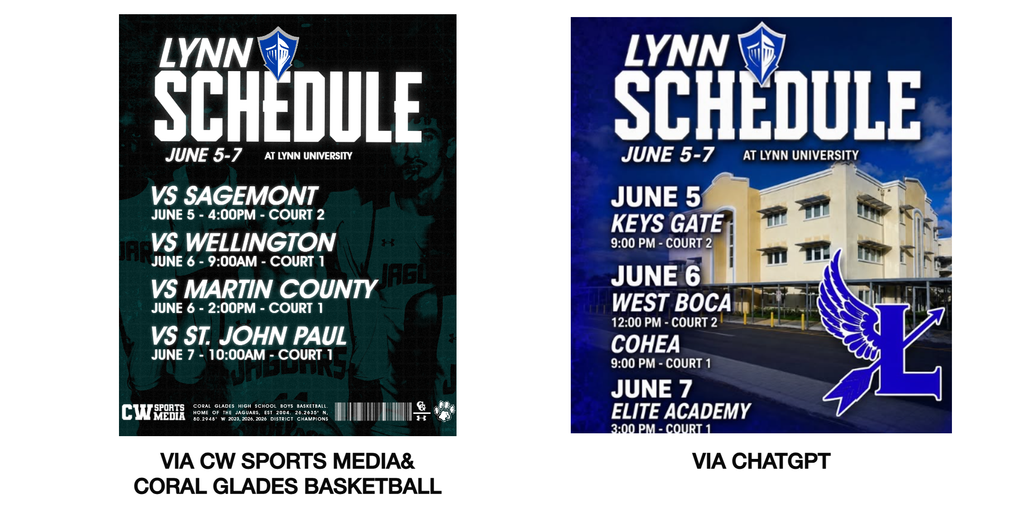
Above is an example of use of Image generation to steal content. The post on the left is the original, and as you can see it’s a lot cleaner than the one on the right. It was clearly used to prompt the image on the right. Would you consider this copyright infringement?
Examples similar to this have become really popular just because there is no barrier to entry when using AI.
Environmental Concerns
Furthermore, environmental factors are important to evaluate.
While this is a newer topic that we don’t have much data on, a report by United Nations University provided some shocking data.
“The energy required to generate a typical AI image is enough to power a 10-watt LED bulb for 17 minutes”
“Similarly, the electricity-associated water footprint is about two tablespoons (29 mL) for a single image, but jumps to 4.1 liters for a complex video—almost equivalent to a two-day drinking water need for one person.”
This date is striking because those numbers are high and in high quantity. We can infer that millions of images are made every day using ChatGPT and other image generation tools. This means the amount of power being used is multiplies by much more than if people simply wrote their own captions or made their own images.
What Can We Do?
The answer to this is simple, think for ourselves and use less AI. Creatives exist to help brands express themselves and too much of computer generated content can do more harm than good.
In 2026, we should absolutely be using AI to help with the tedious things, right our wrongs, and be a tool. But it should never be the full basis of everything. As it continues to be used more and more, we should use our creative minds as an advantage.
In the past, having graphics and more social media content was scarce because of the effort it takes. However, now, having really good graphics and social media content is scarce. This is because when everything looks the same it’s much easier to stand out.
The main point I want to be taken away from this educational piece is to use your tools to your advantage! Not your disadvantage! Don’t let a tool get rid of the creative effort that comes in marketing. Also be mindful of how much you use it, and what your using to generate because you never know what rule you can be breaking.
In the midst of AI generated content, what will you do do stand out?
Works Cited
https://unu.edu/inweh/news/environmental-cost-of-AIs-Enrgy-use-carbon-water-and-land-footprints
https://openai.com/index/introducing-chatgpt-images-2-0/
https://www.copyright.gov/engage/visual-artists
x.com (formerly Twitter)